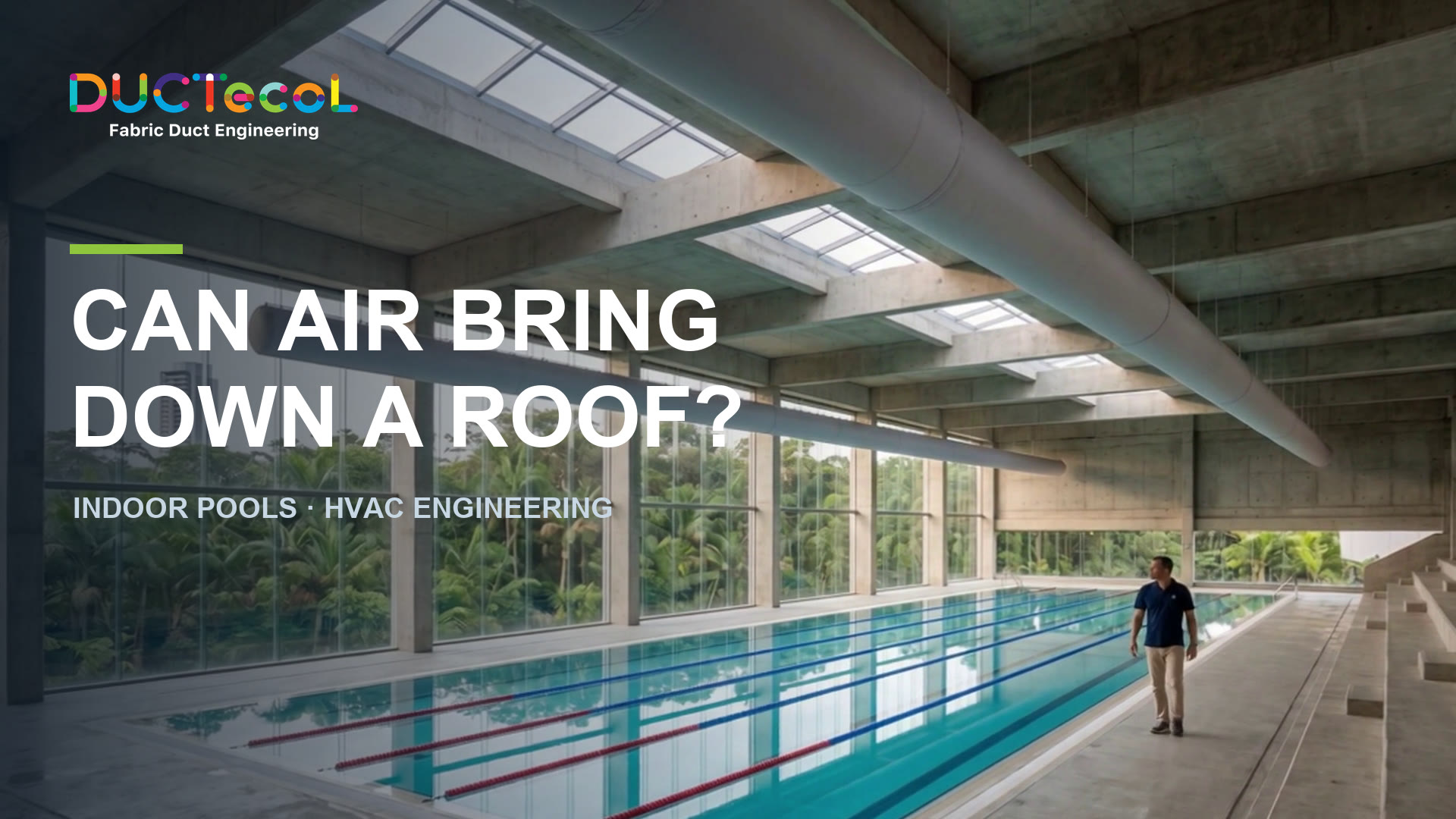
In 1985 the concrete roof of an indoor pool in Uster, Switzerland, fell onto the swimmers and twelve people died. The stainless steel rods holding it had been cracking for years from chloride-induced corrosion, at a temperature engineering considered safe. The water was not the cause: the air was.
A space that manufactures its own corrosive agent
An indoor pool is one of the most demanding spaces in air conditioning. The water surface evaporates continuously, and ASHRAE models that evaporation with an equation where air velocity over the water is a direct variable: going from 30 to 125 fpm across the surface raises evaporation by roughly 30 percent. The designer walks a tightrope. Move too much air and the latent load spikes. Move too little and the vapours stagnate exactly where people breathe.
The reference criteria are narrow: air 1 to 2 degrees Celsius above water temperature without exceeding 30 degrees Celsius, design relative humidity between 50 and 60 percent, and the space held at negative pressure so moisture does not migrate into adjacent areas. Outside that range humidity finds the cold surfaces: glazing, frames and, above all, the hidden roof structure. The ASHRAE manual itself warns that in the worst case the roof could collapse from corrosion caused by water condensing on the structure.
Chloramines: the chemical price of disinfection
The chlorine that keeps the water safe reacts with what bathers bring in, sweat, urea and organic residue, and produces chloramines. The most aggressive is trichloramine, the familiar pool smell that irritates eyes and airways. It is not clean chlorine. It is new chemistry, denser than air, accumulating right above the surface.
A study published in Frontiers in Built Environment in 2022, using CFD modelling on a Montreal pool, measured 1,910 ppb of trichloramine in the swimmer breathing zone at water level, against markedly lower values at standing height. Its conclusion is uncomfortable for common practice: the ventilation minimums set by standard are insufficient to clear that accumulation.
That vapour does not stay low. It rises, condenses on the cold metal of the roof, dries, and the cycle repeats, concentrating chlorides exactly where nobody cleans. The British Health and Safety Executive states it plainly: chloramines are the most important factor in stainless steel corrosion in the pool environment.
What happens to metal hanging over the water
Uster was not an isolated case. In 2001, in Steenwijk, the Netherlands, the suspended ceiling of another pool came down with the air ducts included, through the same mechanism in 304 stainless fixings. In 2003 it happened again in Finland. The pattern is always the same: highly stressed parts, in a chlorinated atmosphere, that nobody washes.
The technical detail that misled a generation of designers is temperature. Stress corrosion cracking in austenitic steels was considered a problem above roughly 55 degrees Celsius. In pools it occurred at thirty. That is why the HSE concludes that grades 304 and 316, perfectly valid underwater or at the pool edge, must not be used in safety-critical load-bearing components inside the hall atmosphere.
A duct lives precisely in that zone: against the roof, in the layer where chlorides concentrate most, with no cleaning regime at all. So it is worth being direct about the materials specified out of habit:
- Galvanised sheet. It corrodes, and the rust ends up dripping onto the pool basin.
- Pre-insulated aluminium. Sandwich panels with aluminium faces suffer chloride pitting in pool atmospheres.
- Fiberglass duct board. Rigid board with foil facing absorbs moisture through the cut edges and encourages microbial growth in an environment that is humid by definition.
- Stainless steel. The grade that genuinely resists is not 316: it is alloys with around 6 percent molybdenum, the same specified for desalination, at three to four times the cost of conventional stainless. Even then, guidance requires inspection of critical components at least twice a year.
Why technical fabric changes the problem
Fabric duct does not compete with metal on corrosion resistance. It steps out of the equation. Synthetic materials take no part in the electrochemistry that cracks steel. There are no chlorides pitting a surface and no stresses propagating a crack.
The selection, however, is not generic. At DUCTECOL we work with a wide range of technical textiles, polyamides, aramids and other polymers, and depending on the process in each zone we run a chemical compatibility study before defining the material. And not only the fabric: threads, hooks and every component of the system are chosen to withstand that specific atmosphere.
On top of that, the air pattern the manual asks for is exactly what fabric produces by design: sweeping dry air across the glazing so it does not condense, barely touching the water surface, and diffusing uniformly with no draughts over bathers. Laser micro-perforations and calibrated nozzles allow that pattern to be tuned metre by metre, something that grilles on rigid ductwork achieve only with far more costly engineering.
Weight, cost and maintenance
A fabric duct weighs around a tenth of the equivalent metal run. On a structure already working in an aggressive environment, that difference in suspended load is not minor. Industry documentation reports savings between 30 and 70 percent in total installed cost against metal ductwork, counting transport, installation and maintenance. Against the high-grade stainless a pool would actually require, the gap is wider.
Maintenance closes the argument. The duct comes down by its zippers and is washed at 40 degrees Celsius. No repainting, no passivation, no crack inspection twice a year. And hygiene is audited by washing, something a rigid system cannot offer.
Frequently asked questions
Does fabric duct resist chlorine without coatings?
Synthetic materials take no part in the electrochemical corrosion that attacks steel. Even so, resistance depends on the specific textile and on the chemistry of each hall, which is why selection follows a chemical compatibility study and extends to threads, hooks and accessories.
What is the design relative humidity for an indoor pool?
Between 50 and 60 percent as a design value, with air 1 to 2 degrees Celsius above water temperature and not exceeding 30 degrees Celsius. The hall must be kept at negative pressure relative to adjacent spaces.
Why is specifying 316 stainless not enough?
Because the British HSE advises against grades 304 and 316 in safety-critical load-bearing components inside the pool atmosphere, following the stress corrosion collapses documented since 1985. The grades that do resist cost three to four times more than conventional stainless and still require periodic inspection.
How is a fabric duct cleaned in a pool?
It comes down by its zippers and is washed at 40 degrees Celsius. That cycle replaces the repainting, passivation and inspection that metal ductwork demands in a chlorinated environment.
The materials discussion in a natatorium is not settled by comparing the price per metre of the first installation. It is settled by putting three variables on the table that traditional ductwork usually leaves outside the budget: the cost of the steel grade that genuinely resists that atmosphere, the inspection regime that material demands across the life of the building, and the load the structure has to carry in an environment that is attacking it. Once those three enter the comparison, technical fabric stops being the alternative and becomes the starting point.
Request the chemical compatibility study and sizing for your natatorium at fabricduct.co.