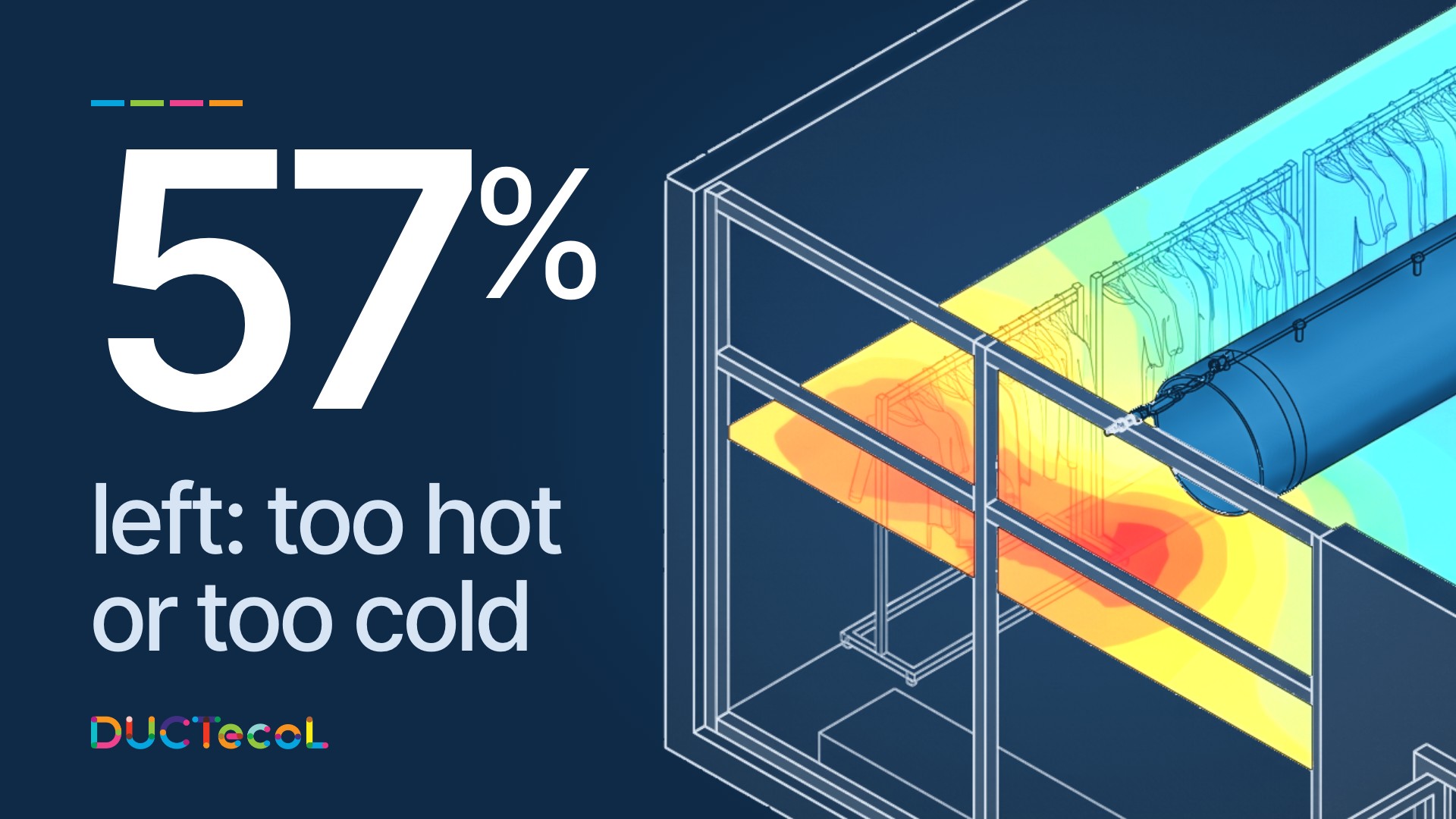
An apparel store is controlled to one thermostat reading, but shoppers and staff feel something else: a cold jet at the register, a warm fitting room at the back, a drip line over a rack of white shirts. Each of those failures starts in how, and from where, the air reaches the sales floor, not in the tonnage of the equipment.
A store is a transition space, not a setpoint
ANSI/ASHRAE Standard 55-2023, in its informative Appendix E, lists retail stores among outdoor-to-indoor transitional spaces. A shopper walking in from a sidewalk at 91 degrees F (33 degrees C) carries stored body heat, and that discomfort can persist for over an hour. The same appendix suggests more air movement there: the target is uniform, controlled air, not still air.
Loads are uneven too. ASHRAE HVAC Applications, Chapter 2, Retail Facilities, notes that stores often have a high internal sensible gain relative to total gain, while the outdoor air required for ventilation may impose a high latent load at the equipment. Glazing takes solar gain, display lighting loads the racks, the door admits outdoor air, and the fitting rooms sit farthest from the outlets.
How conventional outlets deliver the air
Ceiling diffusers under an open ceiling
A diffuser throws a jet. Attached to the ceiling by the Coanda effect, the jet travels; once the negative buoyancy of the cold air overcomes its momentum, it separates and can dump into the occupied zone. Exposed-structure stores make it worse: ASHRAE notes that an outlet mounted about 12 in. (300 mm) or more below the ceiling typically does not attach, has a shorter throw and can project downward.
Cassettes and ductless mini-splits
Four-way cassettes and wall-mounted units discharge from a single point, and cassettes are marketed with uniform 360-degree discharge. Yet velocity maps published by two equipment manufacturers show jet lobes above 100 fpm (0.5 m/s) crossing the occupied zone, with the rest of the section in the lowest band of the map. ASHRAE’s Chapter 58, Room Air Distribution, sets the reference: comfort is maximized with uniform temperature and average occupied-zone velocities below 50 fpm (0.25 m/s). That criterion applies to every mixing system, fabric duct included.
Draft complaints grow faster than velocity
ASHRAE Fundamentals, Chapter 9, carries the Fanger draft model, in SI form:
PD = (34 – t_a) * (V – 0.05)^0.62 * (0.37 * V * Tu + 3.14)
PD is the percentage of people dissatisfied by draft, t_a the local air temperature in degrees C, V the local mean air velocity in m/s and Tu the turbulence intensity in percent. At 75 degrees F (24 degrees C) and a turbulence intensity of 40%, our calculation gives about 7% dissatisfied at 20 fpm (0.10 m/s) and 32% at 60 fpm (0.30 m/s).
Standard 55 applies its local discomfort requirements only to occupants below 0.7 clo and 1.3 met. A shopper walking the floor (1.7 met) falls outside; a cashier or associate standing at a post (1.2 met) falls inside.
Moisture over the merchandise
ASHRAE’s department store guidance names one room outright. It says close humidity control is not necessary, but the system should hold relative humidity at 50% or below, which retards perspiration “particularly in fitting rooms.” Humidity is the equipment’s job; the duct’s job is to get conditioned air to the back row of fitting rooms.
At 75 degrees F (24 degrees C) and 60% RH the dew point is about 60 degrees F (15.8 degrees C, psychrometric calculation), while supply air typically leaves at or above 52 degrees F (11 degrees C). An uninsulated metal duct runs close to supply temperature, and ASHRAE Fundamentals, Chapter 23, warns that moisture on cold ducts may remain in place or drip.
Cassettes and mini-splits hang the coil, the drain pan and, in cassettes, a condensate pump over the racks. If the filter loads and airflow drops, the coil surface can fall below 32 degrees F (0 degrees C) and frost; on thaw, water can overflow the pan.
ASHRAE’s department store guidance recommends locating air-conditioning equipment in mechanical rooms or on the roof, not in the sales area, whenever practicable. The handbook frames it around maintenance, but the same move takes the drain pan away from the product. A permeable fabric duct then delivers air below the room dew point without condensing on its surface, because air passing through the fabric keeps humid room air off it.
Noise on the sales floor side
ASHRAE indicates that at or above NC 35, background noise may interfere with speech intelligibility. Sound from a given diffuser rises with the fifth to sixth power of velocity, so doubling it adds 15 to 18 dB (calculation). Large, flat, unreinforced sheet-metal panels near the fan add duct rumble: ASHRAE reports 65 to 95 dB between 16 and 100 Hz in occupied spaces.
A well-designed fabric duct takes those sources off the floor: no vanes, no neck dampers, no flat panels. It does not block fan noise. Discussing breakout, ASHRAE calls fiberglass and flexible round duct essentially transparent to sound, and by the mass law (our inference, not ASHRAE’s) a light fabric behaves the same way, so fan noise is solved at the equipment.
What that rules out over the racks
Galvanized sheet metal can sweat when uninsulated, and its flat panels can rumble. Pre-insulated aluminum and fiberglass duct board rely on tapes and sealants that can lose adhesion over the years, and neither comes down to be laundered. Stainless costs considerably more and, like galvanized, can sweat and rumble. Cassettes and mini-splits put a coil and a drain pan above the stock. None of them belongs over the merchandise.
Relocation, weight and the ceiling as brand
ASHRAE calls for flexibility in department store duct design so departments can move. Fabric sections join with zippers and hang from a tensioned steel cable, so a run comes down and follows the layout. Weight is a calculation: m’ = π · D · w, with w the fabric weight, selected per application. At 20 in. (500 mm), each 3 oz/yd² (about 100 g/m²) of fabric adds roughly 0.11 lb/ft (0.16 kg/m). Galvanized duct of that diameter weighs about 5 to 6 lb/ft (7.3 to 9.1 kg/m), our calculation from SMACNA 1995 tables.
ASHRAE states that air distribution products must also satisfy the visual aesthetic set by the architect, and it names smudging, the dust a jet deposits around diffusers. Fabric can be dyed to brand colors, printed, made half-round or quarter-round against a wall, and fitted with internal hoops that hold its shape when the fan stops.
Modeled before it is cut
DUCTECOL models each store first: storefront solar gain, lighting, door infiltration, fitting rooms. The simulated occupied-zone velocities are checked against Standard 55, and the laser cuts the resulting perforation pattern. These ducts serve stores of several fashion brands and sporting-goods chains in several countries across the Americas, manufactured in Colombia by a company with projects in more than 30 countries.
Frequently asked questions
Does a fabric duct meet the 50 fpm occupied-zone target on its own?
Not automatically. ASHRAE describes the linear vent outlet, many small outlets in a row, as giving uniform airflow with a throw suited to retail spaces, but the result still depends on orifice size, rows, orientation and mounting height. That is why occupied-zone velocities are verified in simulation before fabrication instead of being assumed from the material.
Will a fabric duct keep condensation off the merchandise in a humid climate?
On the duct surface, yes, when the fabric is permeable: ASHRAE states that slightly permeable material allows air below the dew point without condensation forming on the fabric. Non-permeable fabric is applied like uninsulated single-wall metal and belongs where condensation risk is low. The duct does not dehumidify the store; room humidity is still set by the equipment and the outdoor air load.
Is a fabric duct quieter than sheet metal with diffusers?
It removes the typical sales-floor sources, meaning diffuser vanes, neck dampers and flat panels that rumble. Fan noise still passes, so the equipment and its connection need acoustic treatment. On the metal side, ASHRAE notes that an elbow, abrupt transition or balancing damper just upstream can raise a diffuser up to 12 dB above catalog data. A poorly designed fabric duct can flutter or pop on start-up; for noise-sensitive areas ASHRAE recommends lower internal velocity in cylindrical fabric ducts, 1,000 to 1,200 fpm (5.1 to 6.1 m/s).
How is the system cleaned, and what filtration does it need?
Sections separate at their zippers, come down, go through an industrial laundering process that preserves the fabric’s permeability (a poorly executed wash alters it, and with it the air diffusion) and are reinstalled. ASHRAE notes that polyester absorbs very little moisture and is easy to launder, considers upstream filtration essential, and recommends MERV 8 for porous and microperforated fabrics. In-place cleaning of rigid duct under NADCA ACR 2025, by contrast, calls for continuous negative pressure and containment.
Does a colder store sell more?
The evidence does not support it. In a lab study published in the Journal of Consumer Psychology (Zwebner, Lee and Goldenberg, 2014), stated willingness to pay averaged 10.4% higher in a room near 79 degrees F (26 degrees C) than in one near 64 degrees F (18 degrees C), and the one garment tested showed no significant effect. That does not prove warmth sells apparel, but it undercuts overcooling as a sales tool. ASHRAE notes that department store indoor conditions are commonly set at no more than 78 degrees F (26 degrees C) dry bulb and 50% RH for summer design.
Start from the failure the store actually shows. Drafts at the register and warm fitting rooms point to delivery: jets that dump, or lobes that cross the occupied zone while other zones starve. Water on merchandise points to where the coil sits and to cold, uninsulated surfaces in humid air. Noise complaints point to outlet velocity and flat metal panels. A permeable fabric duct fed from equipment outside the sales area answers all three, provided it is designed against the real loads and layout of that store and its occupied-zone velocities are verified before any fabric is cut. If the problem is capacity or dehumidification, the answer is at the equipment, not in the duct.
Request an air distribution sizing study for your store from the DUCTECOL engineering team at fabricduct.co.